
Watching an IPL match in the middle of a pandemic is a unique experience. Between empty stadiums, artificial crowd noise, and the "bio-bubble," the logistical challenges for organizers are immense. Kudos to their efforts!
Thinking about the sheer volume of travel involved in a regular IPL schedule—where each team plays home and away—led me to a question: Can we optimize the schedule to minimize travel while maintaining tournament integrity?

The Strategy: Why Optimization Matters
Maintaining Destinations: While one could host the entire event in a single city, we often must use all destinations due to legal compliance, local economic impact, and reducing the dependency on a single location’s infrastructure.
Variable Risk Levels: In a pandemic, health statistics vary by city. You might want to scientifically minimize exposure in high-risk areas. This calls for a mathematical approach to scheduling.
Enter PuLP: A Linear Programming Package
IPL scheduling can be viewed as a Linear Programming (LP) problem. We define an objective (minimize travel) subject to specific constraints.
PuLP allows us to define the problem in three steps:
- Define Variables: The decision factors.
- Set Constraints: The "rules" that must be followed.
- Define Objective: The cost function to minimize or maximize.
Problem Definition
We have 8 teams and 8 home destinations. In the league stage, each team plays every other team twice, resulting in 56 total matches.
dests = ['Mumbai', 'Hyderabad', 'Chennai', 'Delhi', 'Kolkata', 'Chandigadh', 'Jaipur', 'Bangaluru']
teams = ['MI', 'SRH', 'CSK', 'DC', 'KKR', 'PK', 'RR', 'RCB']
matches = list(range(56))
We define a binary variable where match_var[match_num][p][t1][t2] equals 1 if a match happens at place p between teams t1 and t2, and 0 otherwise.
Formulation and Constraints
Every rule must be explicitly expressed. Even simple logic, like "a team cannot play against itself," must be coded into the solver.
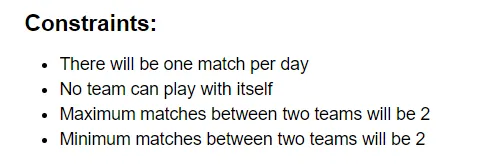
To reduce travel, we assign a numeric "cost" to matches played away from home. By adjusting the cost matrix, we can steer the schedule toward safer or more efficient locations.
The Results
After running the solver, we look for all match variables assigned a value of 1.
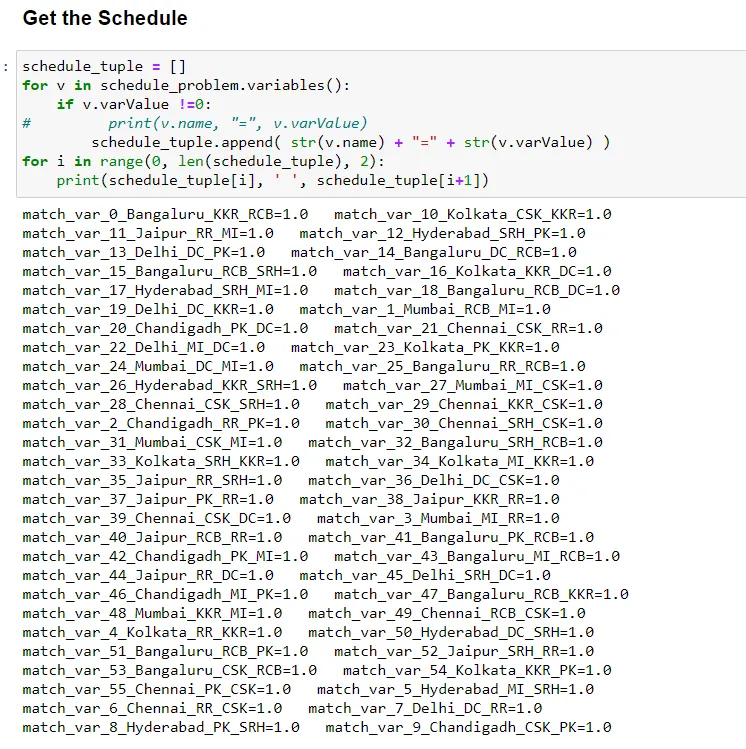
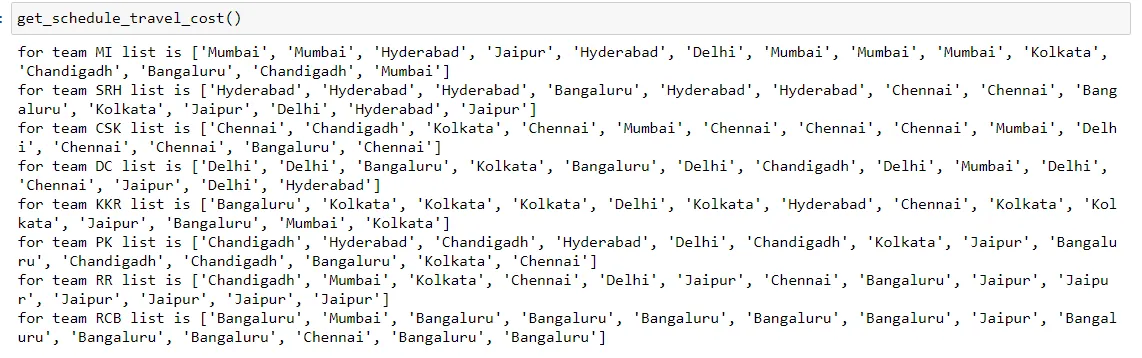
In this model, almost every match includes at least one home team, as the optimizer prioritizes the path of least travel. Below, you can see the distribution of home matches per team:
Did you find this LP problem formulation useful? There is less stuff on PuLP and linear programming in general on the internet. Feel free to connect with me if you want to explore this further.